At “Standards and Quality,” we handle the certification of lifting and transport equipment from the initial application through to the receipt of the documents. And we can honestly say: this category isn’t for those who just want to “get a piece of paper quickly.” It’s serious work. But if you approach it the right way, the process goes smoothly without unnecessary delays.
What regulations govern elevators and escalators?
The first thing to understand is that elevator equipment and escalators are subject to different regulations depending on their type.
Elevators—both passenger and freight-passenger—are governed by the Technical Regulation on Elevators and Safety Components for Elevators, harmonized with EU Directive 2014/33/EU. This is a separate regulation specifically for elevators, and it sets strict requirements for design, installation, and safety components. The elevator itself as an integrated system and its key components (shaft door locks, anti-fall devices, speed limiters) are subject to mandatory conformity assessment involving a designated body.
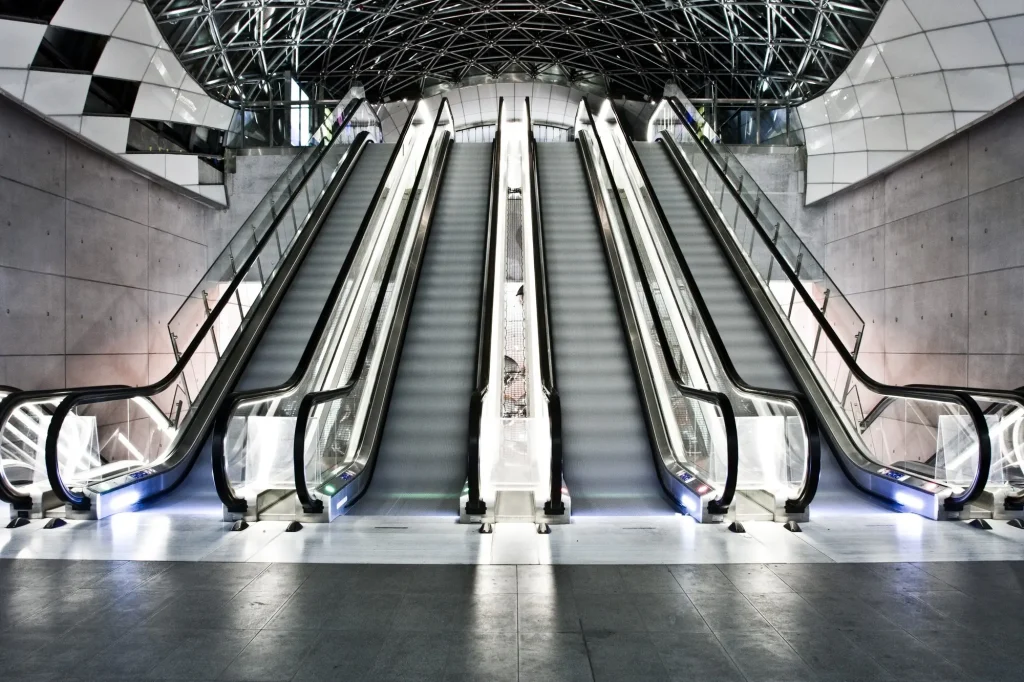
Escalators and passenger conveyors are subject to the Technical Regulation on the Safety of Machinery, which is harmonized with Directive 2006/42/EC. In other words, an escalator is considered a “machine” under this regulation, and it is subject to the general safety requirements for machinery as well as the specific standards of the EN 115 series.
Unattended freight elevators, small freight elevators (such as food lifts in restaurants), and platforms for people with disabilities also have their own specific requirements. Some fall under the regulations for machinery, while others fall under the regulations for elevators. Determining the correct regulation is the first and critically important step, as the entire subsequent procedure depends on it. We had a case where an importer of a platform lift submitted documents under the elevator regulations when they should have submitted them under the machinery regulations—two months of lost time.
Conformity assessment procedure: a third party is essential
Unlike many other product categories, where manufacturers can rely on self-declaration, the involvement of a conformity assessment body is mandatory for elevator equipment. This is not a situation where you can simply draw up a declaration of conformity based on your own tests and start operating. A designated (notified) body is required here.
For passenger elevators, the procedure involves several stages. First comes type testing (type approval). The authority examines the design, verifies the calculations, and conducts tests on a prototype or critical components. This is the longest stage—it can take two to four months, depending on the complexity of the design and the completeness of the technical documentation.
Next comes the production assessment. The authority verifies whether the company is capable of consistently producing products identical to the tested sample. Here, the quality control system, metrological support, and personnel qualifications are evaluated. The presence of a certified management system under ISO 9001 significantly simplifies this stage—a significant portion of the requirements are already met.
For elevator installers, there is a separate procedure. The installation company also undergoes an assessment: the qualifications of the crews, the availability of equipment and tools, installation quality control procedures, and the presence of liability insurance. A final test of each installed elevator is mandatory and is conducted by the conformity assessment body directly on-site. The brakes, speed limiter, door locks, communication system, and stopping accuracy are checked. Only after a positive result can the elevator be put into operation.
Technical documentation: what should be included
Technical documentation for elevator equipment is among the most comprehensive of all product categories. The minimum set includes: a general description of the design with drawings and diagrams; calculation results (strength, traction, and hydraulic—depending on the drive type); electrical and hydraulic diagrams of control and safety systems; a list of applicable standards; risk assessment results; test reports; installation, commissioning, and maintenance instructions; and a shaft wiring diagram.
For imported equipment, this entire set must be translated into Ukrainian. And this is not a mere formality—the assessment authority actually reads the documentation, and if the translation is of poor quality or contains technical errors, the documents will be returned for revision. We have encountered a situation where a Chinese manufacturer provided a “translation” generated by an automatic translator—the authority refused to consider it immediately.
If the equipment is manufactured according to custom specifications rather than DSTU standards, technical specifications must be developed in advance. For elevator equipment, technical specifications are a document of particular importance, as operational safety for decades to come depends on the accuracy of the parameters specified therein.
Special considerations for imported equipment
Importing elevators and escalators is a whole different story, and this is where we see the most problems in practice. The main mistake importers make is assuming that a European certificate is automatically valid in Ukraine. No, that is not the case. Even if an elevator has CE marking and a certificate from a European notified body, a separate conformity assessment procedure in accordance with Ukrainian technical regulations is required for the Ukrainian market.
However, having European documentation significantly simplifies the process. Test reports from recognized European laboratories can be accepted by the Ukrainian conformity assessment body without retesting—provided they cover all necessary parameters and are conducted according to standards harmonized with Ukrainian ones. We always recommend that importers request a complete set of documentation from the European manufacturer before signing the contract—this can save several months and a significant amount of money on testing.
Another issue is the adaptation of documentation. The European declaration of conformity and the Ukrainian one differ in form and content. The instructions must comply with Ukrainian requirements, the labeling must be in Ukrainian, and the declaration must refer to Ukrainian technical regulations rather than European directives.
Timeline and estimated budget
For those planning to enter the market with elevator equipment, I’ll outline realistic timelines—the ones we deal with every day, not the promotional ones. The full certification cycle for lifting and transport machinery for a new elevator model takes three to six months. This includes preparing documentation, type testing, testing, and issuing the certificate. For imported equipment with a complete set of European documentation, it can be faster—two to three months.
For escalators, the procedure is usually shorter, as certification under the machinery regulations involves a slightly different set of assessment modules. However, the specific nature of escalators—their large size and the inability to transport a sample to a laboratory—often requires testing to be conducted directly on-site, which adds logistical complexity.
The budget depends on the type of equipment and the scope of the required testing. As a guide: full product certification for a new model of a passenger elevator is a significant investment, but it opens up access to the entire Ukrainian market. And considering that a single elevator costs anywhere from several hundred thousand to millions of hryvnias, certification costs represent a relatively small portion of the total.
The “Standards and Quality” team guides the process from identifying applicable regulations to obtaining the final documents. We work with both Ukrainian manufacturers and importers from China, Turkey, and Europe—we understand the specific documentation requirements of each market. If you are a manufacturer or importer of elevator equipment and are planning to enter the Ukrainian market—please contact us. We will analyze your situation, identify the applicable regulations, and develop a plan with specific timelines and a budget.