In this article, the Standards and Quality team examines the requirements for three main groups of children’s products—toys, textiles, and furniture—and explains what documents are needed to legally enter the market. The article will be useful for both Ukrainian manufacturers and importers who are working with children’s products for the first time.
Toys: technical regulations and what they require
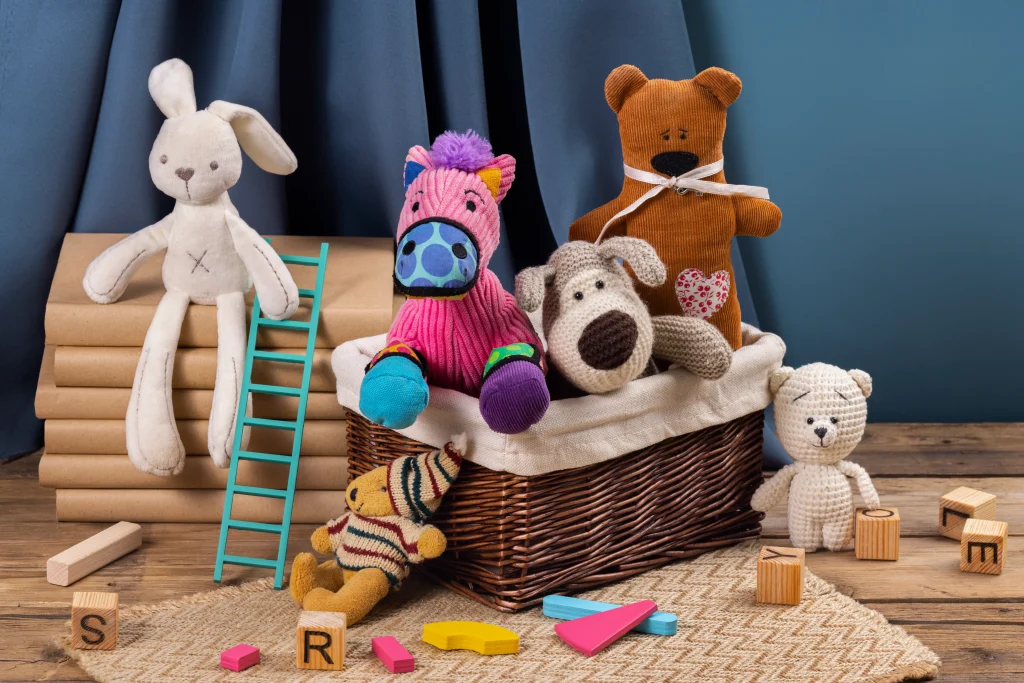
Ukraine has Technical Regulations for Toy Safety, harmonized with EU Directive 2009/48/EC. These regulations apply to any products intended for children under the age of 14, regardless of whether they are marketed as “educational,” “decorative,” or “collectible.” If a product can be used by a child for play, it is considered a toy from a legal standpoint.
Certification of children’s toys involves testing for several groups of indicators. Mechanical and physical safety: strength of soft toy seams, absence of small breakable parts (risk of swallowing), sharp edges and corners. Chemical safety: content of heavy metals, phthalates, formaldehyde, and other harmful substances in materials. For toys with electrical components, electrical safety requirements are added. For toys that come into contact with the mouth, microbiological tests are required.
The manufacturer is required to draw up a declaration of conformity and compile a technical file containing a description of the product, risk assessment results, test reports, and labeling samples. For most categories of toys, self-declaration is sufficient—the manufacturer independently confirms compliance based on the protocols of an accredited laboratory. However, for chemical toys (experiment kits), water toys, and certain other categories, the involvement of a conformity assessment body is required.
Children’s clothing and textiles: safety of fabrics and accessories
Children’s textiles are subject to general safety requirements for non-food products and additional sanitary and hygiene requirements. Certification of light industry products for children’s ranges is significantly stricter than for adult clothing, especially for products intended for children under three years of age.
The main requirements concern three aspects. The first is the chemical safety of fabrics. The content of formaldehyde, aryl amines, heavy metals in dyes, and the pH level of water extracts—all these indicators are regulated much more strictly for children’s textiles. The second is the mechanical safety of accessories. Buttons, zippers, and decorative elements must withstand a specified pull force—a child should not be able to pull off a small element and swallow it. The third aspect is flammability. For children’s clothing, especially nightgowns and pajamas, there are separate requirements for fire resistance.
Для прохождения сертификации продукции детского текстиля производителю необходимы протоколы испытаний по полному перечню показателей и санитарно-эпидемиологическое заключение, подтверждающее безопасность материалов для контакта с кожей ребенка. Заключение обязательно для всех изделий первого слоя — тех, которые непосредственно контактируют с телом.
To obtain certification for children’s textile products, manufacturers must provide test reports covering a full range of indicators and a sanitary and epidemiological report confirming that the materials are safe for contact with children’s skin. The report is mandatory for all first-layer products — those that come into direct contact with the body.
Children’s furniture and equipment: stability, construction, materials
Cribs, high chairs, playpens, changing tables — a separate category with its own safety standards. Key requirements: structural stability (the product must not tip over under the intended load, including situations where the child tries to climb out on their own), no pinch points for fingers and limbs, safe distance between elements (cot bars must be at a certain distance from each other so that the child cannot stick their head through) Each type of children’s furniture is regulated by a separate standard of the DSTU EN series, and the requirements vary significantly.
Materials are also subject to control: paint coatings are tested for lead and other heavy metals, wood-based panels are tested for formaldehyde emissions. For children’s furniture, it is mandatory to obtain a sanitary and epidemiological conclusion on materials that may release harmful substances into the indoor air.
If children’s furniture is manufactured not in accordance with the national standard DSTU, but according to the company’s own specifications, it is mandatory to develop technical specifications in advance. Technical specifications define requirements for design, materials, control methods, and labeling rules. Without approved technical specifications, the manufacture and sale of children’s furniture is illegal.
Labeling of children’s products: mandatory elements
The labeling requirements for children’s products are stricter than those for “adult” products. Each product must contain: the name and address of the manufacturer, the name of the importer (for imported goods), age labeling (the age for which the product is intended), a hazard warning (if applicable), a mark of conformity with technical regulations, and instructions for use in Ukrainian.
Toys must bear the CE marking or a mark of conformity with technical regulations and indicate age restrictions. The symbol “not for children under 3 years of age” must be affixed to all toys with small parts. For textiles, the fabric composition, care instructions, and size must be indicated. For furniture, information about the maximum load and age restrictions must be provided.
Incomplete or incorrect labeling is one of the most common reasons for market surveillance authorities to withdraw children’s products from circulation. Even if all declarations of conformity and certificates are available, a product with labeling violations may be blocked from sale.
Documents: complete package for manufacturers and importers
For the legal sale of children’s products on the Ukrainian market, the manufacturer or importer must provide several key documents. The declaration of conformity is the basic document confirming that the conformity assessment has been passed. Laboratory test reports are the basis for the declaration, issued by an accredited laboratory for a complete list of indicators for the relevant category.
Санитарно-эпидемиологическое заключение — обязательно для товаров, контактирующих с кожей ребенка, с ротовой полостью или выделяющих вещества в воздух. Технические условия — необходимы, если продукция производится не по ДСТУ. Технический файл — полный комплект документации, хранящийся у производителя и предоставляемый контролирующим органам по запросу.
Sanitary and epidemiological conclusion — mandatory for products that come into contact with a child’s skin or mouth, or that release substances into the air. Technical specifications — required if the product is not manufactured in accordance with DSTU standards. Technical file — a complete set of documentation stored by the manufacturer and provided to regulatory authorities upon request.
For imported goods, the following are also required: documents from the foreign manufacturer regarding product safety, instructions and labeling translated into Ukrainian, a contract, and an invoice.
Common problems and how to avoid them
Based on the experience of Standards and Quality, the most common problems with the certification of children’s toys and other children’s products are related to three situations. The first is when the manufacturer or importer does not know that their product is considered “children’s” from a legal standpoint. A decorative figurine that an adult buys for interior decoration may be classified as a toy if its characteristics make it attractive to children.
The second is incomplete testing. The manufacturer orders only basic mechanical tests, forgetting about chemical safety or flammability. A protocol with an incomplete list of indicators is not a basis for a declaration of conformity, and repeat tests will have to be ordered.
The third is ignoring age classification. Significantly stricter requirements apply to children under three years of age than to older age groups. If a product is incorrectly labeled as “from 3 years old” but can actually be used by younger children, the regulatory authority has the right to require testing according to stricter standards.
Standards and Quality helps manufacturers and importers of children’s products go through all stages of product certification: from determining the category and list of necessary tests to preparing a complete set of documents. Contact us for advice — we will help you bring your products into compliance with safety requirements and avoid delays in entering the market.